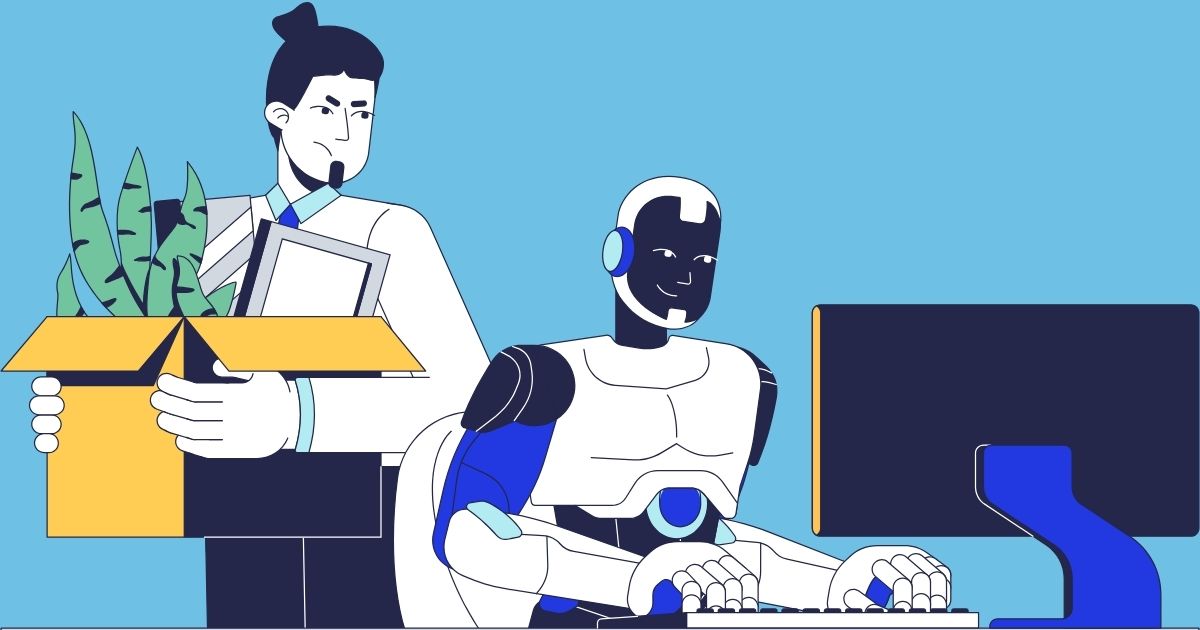
And how people might still earn, contribute and stay afloat
As AI removes entry-level jobs, many people are left willing to work but locked out of paid employment. This article explores how contribution still happens and why new systems are needed to recognise it properly.
Many people are asking the same question right now, even if they’re phrasing it differently.
What happens when the jobs people used to start with no longer exist?
Entry-level roles are shrinking. Administrative work is being automated. Junior professional jobs are increasingly done by software. For young people and career changers, the ladder looks shorter… or is missing altogether.
Unfortunately this isn’t something to worry about in the future… it’s happening now.
And it raises a more uncomfortable question.
If paid work becomes harder to access, how do people earn, contribute and pay their bills?
AI is changing work faster than we can adapt
Artificial intelligence isn’t just making people more productive. In many cases, it’s removing the need for certain roles entirely.
Historically, technology displaced some jobs but created others. The concern now is speed and scale. Entire layers of routine and junior work are being removed faster than new pathways are appearing.
This leaves many people stuck:
- qualified, but underused
- willing to work, but locked out
- contributing informally, but invisible to the system
Unemployment is the reality that we will be living in, but what is more concerning is how people will simply disengage from society.
Governments can’t fund everything forever
When jobs disappear, the default response is often to look to government support.
But large-scale, long-term income replacement is expensive. Social welfare systems were not designed to absorb whole segments of the workforce permanently.
Even where support exists, it often:
- strips people of dignity
- discourages contribution
- treats citizens as costs, not assets
That’s not a sustainable solution.
People don’t stop contributing when jobs disappear
One thing often gets missed in these conversations.
When paid work becomes scarce, people don’t suddenly become inactive.
They:
- care for family members
- support neighbours
- volunteer
- share skills
- keep community organisations running
This work is real. It creates social stability. It reduces pressure on public services.
But it sits outside the wage economy, largely unmeasured and unrecognised.
That’s the gap we need to address.
A missing layer between work and welfare
If paid employment no longer guarantees participation for everyone, societies need an additional layer where it recognises contributions beyond the payroll system.
This is where the idea of a Community Economy becomes relevant.
Not as ideology.
As infrastructure.
A way of recognising, recording and eventually rewarding community contribution so that people remain economically and socially engaged, even when traditional work is unavailable.
What Investors in Community is building now
At Investors in Community (IIC), we’re focused on the practical foundations of that idea.
Right now, we provide a platform where people, charities and businesses connect around real community action. When someone gives time, skills, items or funding through the platform, that action is verified and recorded.
This creates Community Credits.
Community Credits are not wages.
They are not a substitute for employment.
They do not solve the problem overnight.
What they do provide is proof.
Proof that contribution happened.
Proof that effort exists beyond paid work.
Proof that communities are already producing value.
That proof matters if any future system is going to work.
Why the exchange comes later
The most important piece, the Community Credit Exchange, is still in development.
This is the mechanism that could allow verified community contribution to circulate and play a role in how people meet everyday needs.
But this only works if the groundwork is solid.
You can’t build an exchange without trust.
You can’t build trust without consistent data.
You can’t create data without systems that already work.
That’s why this is being built in stages.
Why businesses and sponsors have a role
Businesses are not separate from this challenge.
They are:
- facing automation themselves
- struggling to recruit and retain staff
- under pressure to demonstrate social value
- dependent on healthy, functioning communities
Supporting infrastructure that recognises contribution is long-term risk management.
Sponsors help fund the slow, careful work of building systems that may soon become essential for a majority of the population.
The question we need to answer
As AI reshapes work, the question isn’t whether people will still contribute.
They will.
The question is whether we build systems that recognise that contribution, or whether we allow large parts of the population to become economically invisible.
At Investors in Community, we’re choosing to build those systems carefully, practically and in the open.
Because if work alone can no longer guarantee participation, then contribution has to count in other ways too.