Preloader Image

Charities can now apply for an award of up to £5,000 from the Matthew Good Foundation as Grants for Good fund increases by 50%

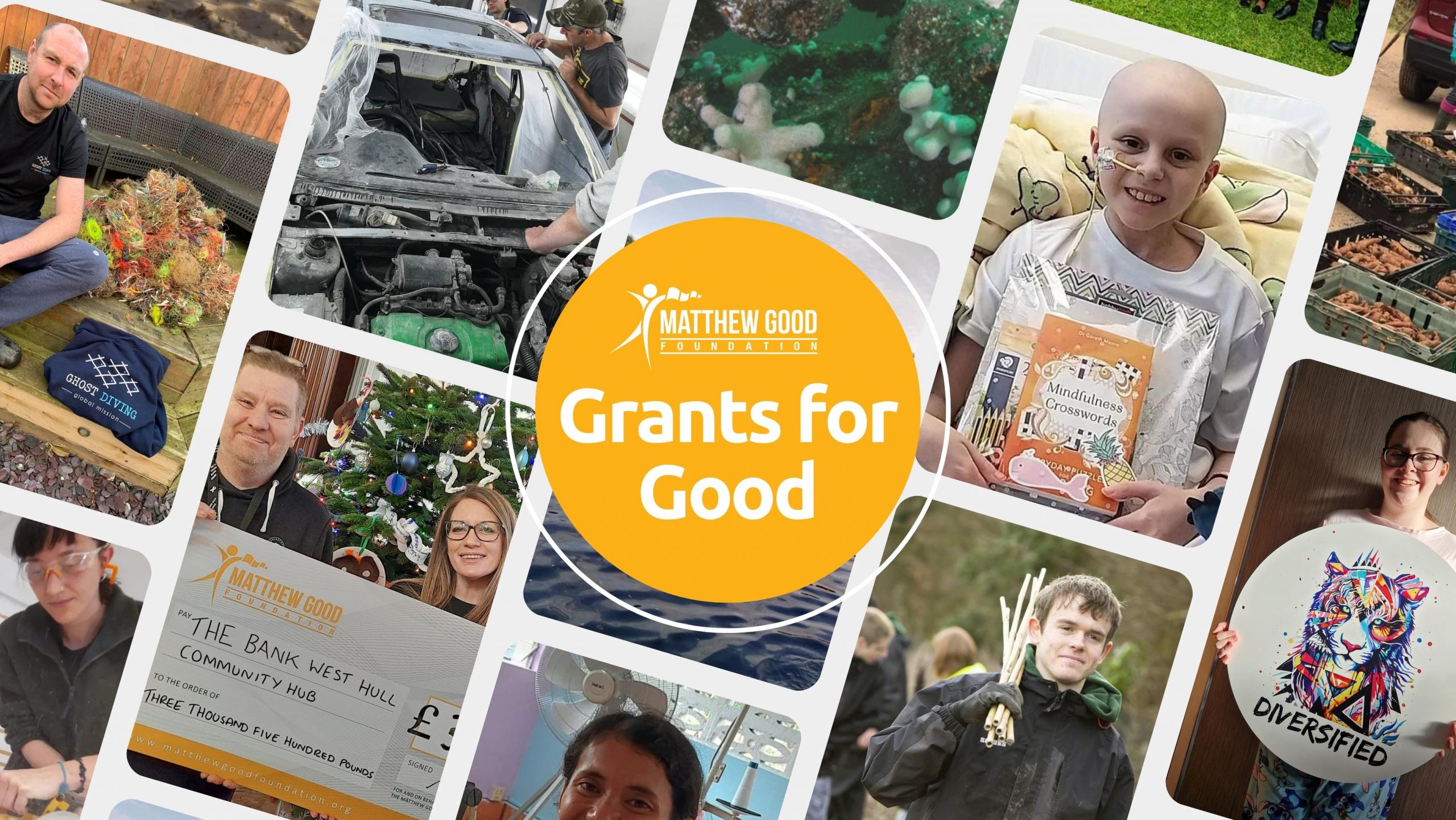
Hull, UK: The Matthew Good Foundation has increased the amount it will award through its established Grants for Good programme from £10,000 a quarter to £15,000. All shortlisted charities will receive higher amounts, and the award for the winning recipient each quarter will go up from £3,500 to £5000.


The Matthew Good Foundation is a charitable foundation, funded by the John Good Group. Their mission is to amplify small or local charitable causes, whose work is often unseen and underfunded, yet delivers high value social impact. They do this through a wide range of grant making processes, including grassroots project funding and an employee giving programme for the John Good Group. The Grants for Good fund launched in January 2021 and was the first initiative from the Foundation that invited organisations to apply to them for funding.

Initially, the programme awarded £10,000 a quarter to five causes, shortlisted by a panel at the Foundation. Foundation members – who are all employees of the John Good Group – then voted for their favourite to decide who got the largest share. The winner of the vote received £3,500, second place £2,500, third place £2,000 and fourth and fifth place £1,000. This process would be completed every quarter, meaning that annually, £40,000 was awarded between twenty different causes.

For 2023, the Foundation has increased its annual Grants for Good fund by 50% to £60,000, with £15,000 awarded each quarter to five successful applicants. The winner of the members vote will now receive £5,000, second place £3,500, third place £2,500 and fourth and fifth place £2,000 each.

Previous charities with successful applications include R;pple Suicide Prevention – a charity developing technology to intercept searches for potentially harmful online content, The Bank – a new community hub in West Hull, and Clean Planet – a team of trained divers using their skills to remove ghost gear from their local coastline.

The first organisation to be shortlisted and win the vote was Harry’s Hat, a charity founded by the family and friends of Harry, a baby diagnosed with hydrocephalus (water on the brain), with the aims of raising awareness, offering support to affected families, and funding research to improve outcomes. Caroline Coates – co-founder and newly appointed CEO of the charity reflects on the impact of winning the award, “From my personal perspective launching the charity meant sharing our own personal and difficult story, after-all Harry is my son. We wanted to be associated with a funder who genuinely cares about the causes it supports and took the time to get to know them, so the programme was a perfect match! As a newly formed charity, it was so encouraging to know that people believed in our cause and wanted to help. The support helped us launch our first book ‘Hydrocephalus What I wish I’d known,’ given for free to the parents and carers across the UK.  So far, 475 families have benefitted directly as well as 20 neurosurgery units, 34 health visiting teams and numerous front-line workers. In the short time since gaining the award we have supported over 350 families, secured grants to enable us to employ skilled staff to deliver support, funded front-line workers to learn more about the condition, been shortlisted for prestigious national awards and media coverage, and trebled our income.”

Highlighting the reason for the recent award increase, Michelle Taft – Executive Director of the Foundation said, “Those shortlisted for Grants for Good are often extremely innovative, with real potential to grow their impact on society, yet small charities often struggle to secure funding, particularly funding that is unrestricted.  Having seen the impact Grants for Good has had on its beneficiaries over the last two years, we hope this increase in funding available will further help both small and new not-for-profit organisations to thrive.”

Adam Walsh, CEO of the John Good Group commented, “Supporting the Matthew Good Foundation is an essential part of our people and social responsibility strategy at the John Good Group. We believe in giving back to our communities and helping small, local charities that may not receive the attention or funding they deserve. Our employees are at the heart of this initiative, as they have the opportunity to decide where the donations go and make a real impact on the causes they care about. We are proud to be associated with the Foundation and its mission to amplify the voices of small charities and organisations that can make a significant difference with a small grant.”

The Grants for Good fund is designed to be deliberately easy for very small charities or new community interest groups to apply for, with simple guidelines and a minimum amount of information needed to get started. Applicants do not necessarily need to be a registered charity, they could also be a local community group, voluntary group or social enterprise. They must have a positive impact on people or the environment, and their annual income must be below £50,000. Shortlisting is performed each quarter, but applications are open all year round, so those looking to apply can do so whenever they are ready. Full details of the programme and an online application form can be found at www.matthewgoodfoundation.org/grantsforgood.


Media Enquiries

Jennifer Murden
Phone: 07444 479192
Email: jen@matthewgoodfoundation.org

Available Monday – Friday, 9.00am – 2.30pm

About the Matthew Good Foundation

The Matthew Good Foundation is a charitable foundation, funded by the John Good Group. It was formed following the unexpected passing of family member and Director, Matthew Good on June 26th, 2011, whilst running for charity in the Humber Half Marathon. Through the Foundation, John Good Group employees can support charities and good causes they care about. The Foundation also supports innovative small charities with funding and resources to help them achieve their potential.


About the John Good Group

The John Good Group is a sixth-generation family business founded on a clear and community-focused philosophy, which is to create and nurture businesses that are a force for good. Winners of the Yorkshire & Humberside Family Awards 2022 for Family Business of the Year and Best Social Impact and founded on family values; they put their people, planet, and communities at the heart of everything they do. The Group comprises five divisions focusing on Travel, Marine, Warehousing and Logistics, Property, and Renewables. Each of these divisions has its own ambitious strategy for continuous growth, all while uniting under a shared vision for the future.


Social Media Channels

 Matthew Good Foundation

https://www.linkedin.com/company/matthew-good-foundation

https://twitter.com/MatthewGoodFoun

https://www.facebook.com/MatthewGoodFoundation

https://www.instagram.com/matthewgoodfoundation

https://www.youtube.com/@matthewgoodfoundation2122


John Good Group

https://www.linkedin.com/company/john-good-group/

https://twitter.com/johngoodgroup

https://www.facebook.com/johngoodgroup


Websites

www.matthewgoodfoundation.org

www.johngoodgroup.co.uk

Social Value and Social Impact: Understanding the Differences

Today, there is an increasing focus on the impact that businesses have on society and the environment. This has led to the development of two key concepts: social value and social impact. These two terms are often used interchangeably, but it’s important to understand the differences between them.

Social value refers to the positive impact that a business has on society and the environment. This can include creating jobs, supporting local communities, and reducing carbon emissions. Social value can also be measured in terms of the economic, social, and environmental benefits that a business provides to society.

On the other hand, social impact refers to the long-term, sustainable impact that a business has on society and the environment. This includes the positive and negative effects of a business’s activities, and the impact they have on future generations. Social impact can also be measured in terms of the positive changes that a business brings to society, such as reducing poverty, improving health, and promoting equality.

The key difference between social value and social impact is that social value focuses on the short-term benefits that a business provides to society, whereas social impact looks at the long-term, sustainable impact that a business has on society and the environment.

In conclusion, social value and social impact are both important concepts for businesses to understand. By focusing on both social value and social impact, businesses can ensure that they are creating positive change in society and the environment, and that their activities are sustainable in the long-term. By doing so, businesses can build a strong reputation and foster trust with stakeholders, while also creating a better future for society and the planet.


If you want to qualify your social value and start to measure your social impact contact us here www.investorsincommunity.org

There’s no accounting for Social Impact

As the world turned its sights on Social Impact, demonstrated by businesses and companies in the last year or two, and the term ESG (Environmental Social Governance) became commonplace, businesses have started to build this into their new plans.
Why?
 Because Investors and lenders were demanding evidence of activity
 Customers and consumers insisted on good credentials
 Employees were making this a pre-requisite of their employment contracts
 Government contracts insisted on strong evidence to award a reserved average of 30% of the awarding tender marks
In short, it was realised that those businesses who could evidence social value delivery as part of its strategy, and not just as an afterthought, were more likely to BE in business in five years. With sustainability improved, risks reduced, and the collective businesses contributing to both the planet and to local communities
SO, the scene is now well established.
Sales, investment and loans, employee retention, and lower costs, can all be accessed by demonstrating Social Value
Social Impact is now worth real MONEY and real PROFIT
Here is the problem
The way in which the social impact is measured is still based ostensibly on either a corroboration of various systems (Finance, HR, training), or is somehow consolidated into a master spreadsheet, often as a summary of lots of other spreadsheets dotted around the business, each with a different owner, with varying priorities and targets.
The challenge with the above is that there is often no verification, no confirmation by a third party, that the activity and the effort, matches with the declared outcome
In other words, it is open to being fabricated, extrapolated, or wrongly interpreted.
But this cannot be so, if institutional funds, structured competitive tenders, or legal contracts are reliant upon this data being correct and truthful.
You cannot simply present your finance position on a spreadsheet each period and instruct your accountant to file them at companies house, and for HMRC to simply trust you that they are correct.
No, they are audited against data ledgers and nominals in the accounts package, which in turn are reconciled against the bank account statements. This is done to offer proof of position and is a legal requirement of each serving director to undertake.
In August 2022, you may have seen several large blue chip UK companies, becoming investigated by the Competition and Markets Authority (CMA) for making statements about their social impact, that could not be substantiated and could be not true.
It doesn’t matter if they were true or not at that point in time, as the damage was already done by an unforgiving social media news feed.
The awful thing, is that their data, the marketing statements, and the qualitative statements were all generated by many team members, and the directors had no way of knowing or checking their accuracy, yet it is they who are legally responsible.
So, my good readers, who are people with high integrity, and would not seek to make misleading comments, gain pecuniary advantage by extrapolating numbers, or create impact statements out of a story book, to gain access to contracts or funding, this is the problem.
It is now not enough to say, “trust me”, nor enough to be diligent in the preparation of your Social Value data sets. It is time to adopt a system, much the same as a financial accounts system, to protect your company, your brand, your own reputations, and your staff.

In short you need an accounting system for Social Impact.
1. It must be able to record each action taken, in a way that is not changeable- therefore fully auditable
2. Where possible, it should provide an audit trail back to the individual person/ employee, who offered that help
3. It must be verified independently, by the community groups/ charities, or causes that you are helping
4. It should provide transparency, and reporting to confirm the numbers and qualitative statements
5. It should have sufficient flexibility to be able to record any aspect of Social Value that you externally offer, be that Environmental or Social
This is the often overlooked “G” in the ESG map. The G stands for governance, which is designed to protect individual directors against unprovable claims, of actions or outcomes, sometimes called fraud. It also protects the company, and its brand and reputation
In summary, the G is the insurance policy, in a world of rapidly increasing scrutiny.

If you are a senior leader in your business, a director or non-executive director, and you would like to know more, or discuss the challenge of “Accounting for Social Value”, contact me at philip.webb@investorsincommunity.org

Social Impact or Social Unrest?

IIC Transformation Programme

I look around at the myriad of pressures on society this month, ranging from the ever-higher home energy costs, car fuel costs, rising food prices, interest rate increases, and the apparent widening of the divide between those who can afford to live through this period, and those who will need help, and probably need to make lifestyle-limiting choices, as to how they exist into the winter of 2022 and into 2023

I am sensing that we are all approaching a crossroads, that means that there are three ways to go forwards:

  1. Keep Calm and carry on
    1. Rely on government support to be able to afford to live
    2. Or you have sufficient money and resources not to worry too much anyway
    3. “I’m alright Jack” approach, where “self” prevails over community


  1. Social Impact
    1. Start to knit communities together, businesses, charities, social companies, and Individuals – to provide co-support to help those in need, and start to “Level Up Society”
    2. Promote people-through-recognition, to volunteer, gift, and support those who need help
    3. Engage companies to spill out into their local community, to provide help and resources, promoting themselves as a great social impact company


  1. Social Unrest
    1. Where people get fed up with the unfairness, the gigantic “company” profits versus the family without food or heat in their houses, and survival is a matter of luck or a postcode
    2. Where unrest grows to active protests
    3. Where protests grow to violent reactions


It has been said before that the move from polite society to anarchy, takes just three weeks given an opportunity or event. For those who remember the Poll Tax Riots of 1990, you’ll understand this context

They say, it often takes a disaster or a war, to create the shock conditions for people based behavioural change, but the combination of adverse factors we are all currently facing, must surely be an equivalent?

Which path will unfold?

What choices can be made, to avert social unrest, create a joined up, fairer community, and start to close the societal divide, based on compassion and fairness, to create sustainable caring communities?

At Investors In Community, we have the method and the systems to create a solid option 2, and help communities achieve Social Impact, and a positive way forwards.

If you want to know more, contact info@investorsincommunity.org

Peter Schriewersmann works alongside Investors In Community to raise funds for ambulances for Ukraine.

Peter Schriewersmann, a partner in Hotel Anfield, launched his project on the Investors In Community platform to raise money for the purchase of a number of ambulances to gift to the Ukraine. The charitable giving platform, IIC, helps firms to find good causes that need help in their local area. As well as measure, record and report other fundraising, donations and volunteering to show the full extent of their social responsibility.

When he heard of the situation in Ukraine, Peter asked himself: “What can we do, that will have a tangible impact?”

Regarding the project, Peter said “Never ever have I felt as committed to a cause as I do to this one. What is happening in Ukraine is horrendous. A proud European country might cease to exist, I still struggle to comprehend. It makes certain things feel so much less secure.

My wife Joanna, who is from Poland and massively involved with the regional Polish relief effort, has inspired me massively. Last week, she told me, that the Ukrainians are massively short of ambulances. I have seen small numbers of donations of ambulances being made … I spoke to my cousin Thomas, from Rietberg, Germany and he has a close Dutch connection who currently has 11 used Mercedes and VW ambulances for sale. They dropped the price for all of those ambulances to 150000€ plus 5000€ for accommodation, petrol etc.

This project will make a tangible difference. It will save people’s lives. Us ordinary people have the power to make an extraordinary difference.”

In a time where many people were lost and in severely stressful situations, Peter, his friends and family stepped up to provide this support. It was also a difficult time for us to know exactly where we as individuals could donate to support the aid for Ukraine. Peter brought to light something many of us overlooked and enabled many people to offer their support in a way they had not previously thought of.

Peter and his team raised a staggering £30k+ and they were able to successfully drive the ambulances across to Poland for safe delivery into the Ukraine.

Peters kindness and generosity has inspired many and we are thrilled he chose to work with Investors In Community to achieve this incredible feat.

If you’re interested in creating your own charitable project, you can do so here: https://investorsincommunity.org