Preloader Image

The world is getting scary – but it’s not all over yet.

Something, somewhere, is going wrong. Unemployment is predicted to get worse in 2026; the majority of adults see the cost of living as a major issue; and with all our recent Prime Ministers of the past 5 years receiving ever-lower approval ratings, we are living in times of anxiety and unrest.

When I left university, I knew I wanted to go into a role where I could make a difference, to make the most of my privilege of pursuing further education to help others. We hear that this is a growing sentiment among graduates – despite the increasing concerns over costs, new entrants into the workforce are focused on more than just the figure landing in their bank account at the end of the month. An increasing number of people now care about how their work makes them feel: not just striking a work-life balance, but how their work can bring a fulfilling life of its own.

I was lucky, but the graduate pool is growing, unemployment rates are creeping up, whole sectors are being replaced by new technologies. Most jobs are few and far between, let alone the jobs that can provide people with the sense of fulfilment that they desire. You may not feel any sympathy here – many people, if not most, struggle to find fulfilment in their role, but they get on with it, enduring the hours between 9-5, 5 days a week to keep themselves fed, watered, and sheltered.

But is this really something to encourage? To accept as the default? Is there not something going wrong in a system where people spend the majority of their lives working an unfulfilling job, simply to keep themselves alive? With more people set to lose their jobs in 2026, and many more being ushered into roles they dread returning to after the weekend, an alternative to our economic system has never been more vital. Now, with IIC, it’s also never been more achievable.

Imagine instead a world that tangibly rewards the good you do for others; a world in which your self-esteem and sense of purpose is derived not from how high up the ladder you can climb, but the value you’ve added to your community. An alternative world, where your achievements are not measured in incremental wage increases, but the volunteering that you did to support a lonely person, or the toys that you donated to a child born in poverty.

At Investors in Community, we are taking the steps to turn this vision into reality, using Community Credits™ as a vehicle. We are dedicated to creating a new economic system that encourages cooperation and community, rather than competition, by rewarding those who help others. With each act of kindness, each Community Credit earned can be spent – whether that be on the basics such as utility bills, or on treats, like cinema tickets.

We propose a self-contained economy, where you can earn and spend by going out into your community, picking up litter, helping rejuvenate green spaces. This is not just helping others; it’s uplifting the area you live in – it’s helping yourself. The Community Credits™ economy can bring fulfilment in our times of unrest, regeneration in times of decline, and solidarity in times of division. But most importantly, it is a beacon of hope for those left behind.

This is not just on individuals. Businesses – you have a role to play. Arguably, the most important of all. We know that you are trying to give back, and we know that you, too, are hit with rising costs keeping you up at night. The economy as we know it is not working for you, either. But a thriving community supports their businesses, it grows with them, not against them.

So if you’re a business, maybe a small one, maybe a big one, a struggling one or a thriving one – we ask you to join us. Come and take part in a system that rewards and values the good that you can create, not just the exponential profits you generate. Support and source other businesses that care about the world around them. Resist the trend in our crumbling communities of division and degeneration and be a building block in a new community – a new economy.

When does giving pay you back?

A straight-talking look at the real ROI of Social Value

The big question: why give?

Let’s not sugar-coat it: in business, the word “give” usually sets off mental alarms about cost, not value. But what if giving (time, money, gifts, support) paid you back? Not in karma points or good vibes (though you get those too), but in cold, hard business ROI.

We’re talking staff engagement, revenue growth, profit uplift and brand love. Let’s take a look at the real returns from Social Value giving and whether you’re doing it right… or just ticking boxes.

1. Giving comes in more flavours than you think

Social Value giving isn’t a one-size-fits-all gig. Think of it as a portfolio:

  1. – Time: Volunteering, mentoring, skills-based support
  2. – Gifts: Products, services, giveaways with purpose
  3. – Money: Donations, matched funding, community grants

Each one builds a different bridge – to your people, your community and your customers. The win? When that bridge starts driving business growth.

An image split into three vertical columns. The left image is of a bearded man with glasses smiling and shaking hands with someone across a laptop. The middle image is of a man with red hair and wearing a knitted jumper looking down and smiling at his hand which is holding hay. The right side image is of a young woman explaining something with her hands gesturing - she is looking towards a laptop which is off camera, and an older man is in the background smiling. Across the bottom is a purple and blue gradient banner with the words "cash is just one way to give. Time and skills? That counts too.

2. What’s in it for you? The ROI of doing good

Strong team engagement

People want to work somewhere that gives a damn. Businesses with a Social Value mindset see:
– Higher retention (especially Gen Z and Millennials)
– More productivity (people go the extra mile when they care)
– Better hiring results (because your brand values speak volumes)

Revenue that reflects your purpose

Yes, purpose sells.
– Consumers are 4x more likely to buy from brands with values
– B2B clients now expect Social Value data in procurement.
The real return on giving? Growth, loyalty and sales. 

Profits with purpose…and proof!

Worried that giving costs too much? It doesn’t, if it works. 

– Lower churn = less hiring costs
– Higher tender scores = more wins (Social Value scores now carry legal weight in UK bids)
– Loyal customers = longer-term value

A brand people believe in

Social Value transforms blasé brands into real ones. It gives your team stories to tell, your partners

A close up view of a target with an arrow hitting the bullseye which is the Investors in Community symbol. Along the bottom is a black and orange gradient with the words "Purpose sells. And it boosts sales, too

3. The harsh truth: most businesses give…meh

Here’s the tough love. You donate. Volunteer. Sponsor the odd event. But then what? No tracking. No storytelling. No link to strategy.

It’s like planting seeds and never watering them.

So the ROI? Gone.

Two bucket-style plant pots, one pale purple, one mint green. Both have brown unwatered plants in them. Along the bottom is a purple and blue banner with the words "If you're giving and forgetting, don't expect results.

4. Want to flip that? Here’s how. 

Imagine this:

– Every hour your team gives is logged.
– Every pound donated is traced to real impact.
– Every act of goodwill becomes a story, a KPI, a tender advantage.

This is giving that works as hard as you do. 
That’s where platforms like Investors in Community come in. ( Not a plug. Just facts.)
We help businesses prove, improve, and promote their Social Value so the giving actually gives back.

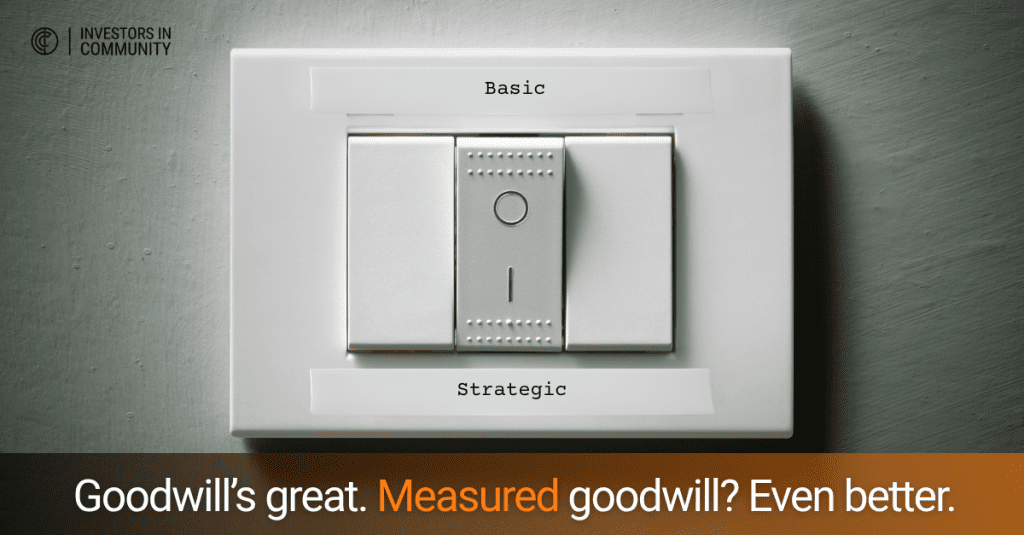
A close up image of a light switch. The off button is labelled "basic" and the on button is labelled "strategic". A black and orange banner runs along the bottom with the words "Goodwill's great. Measured goodwill? Even better.

5. Audit. Accelerate. Win.

– What do you give now? Is it tracked? Tied to business outcomes?
– Set clear metrics: connect giving to staff engagement, tenders, retention.
– Go digital: streamline, track, report.
– Tell the story: Your team and your clients want to see it. Show them.

 Two people with their backs to the camera looking at a computer screen displaying a digital dashboard with colourful charts and graphs. Along the bottom is a black and blue gradient banner with the words "Track it. Prove it. Shout about it. That's how giving pays.

Final Word

Giving, when it’s strategic and well-managed, becomes a growth engine. With the right approach, Social Value fuels loyalty, drives revenue and strengthens your reputation.
So… when does giving pay you back?

When you give with purpose, track with precision and tell the story like a boss.

How social impact drives business success

Social impact is a powerful strategic driver for success. When companies embed social impact into their core operations, they experience a range of benefits that go well beyond good publicity. In this article, we’ll show you how social impact can become a powerful catalyst for growth and long-term success for your business.

Building brand loyalty and trust

Customers and stakeholders are increasingly choosing to support businesses that demonstrate a genuine commitment to social impact. By aligning with causes that matter, companies build loyalty and trust among customers, which can lead to increased brand affinity and repeat business. When businesses can authentically show that they’re making a difference, it resonates with socially conscious consumers.

Attracting and retaining top talent

People want to work for companies that share their values and commitment to social responsibility. A strong social impact strategy can set a business apart in the competitive job market, helping to attract high-calibre employees who are motivated to contribute to a purpose-driven culture. Retention rates improve too, as employees who feel they’re making a positive impact are more likely to stay.

Enhancing operational efficiency

Integrating social impact streamlines operation, as well as reaping the rewards of external benefits. Socially responsible businesses often have clearer governance structures and policies, which translate into more efficient operations. The Investors in Community (IIC) platform, for instance, allows businesses to manage, track, and report on their social impact activities, saving time and reducing the administrative load.

New market opportunities

A commitment to social impact can open doors to new partnerships and client bases. Businesses with strong social value credentials are often favoured in procurement processes and by investors. In fact, many investors now consider a company’s social impact as part of their decision-making criteria. By adopting transparent and verifiable social impact practices, businesses can expand their market reach and appeal to a broader audience.

Mitigating risks and strengthening reputation

Social impact initiatives contribute to risk management by helping businesses avoid reputational damage associated with unethical practices. Platforms like IIC provide transparency and verification for social impact activities, which helps businesses steer clear of greenwashing and demonstrate genuine commitment. A strong reputation in social value can be a buffer against future challenges, safeguarding the business’s long-term viability.

How the IIC platform supports social impact

The Investors in Community platform provides a structured, transparent way for businesses to manage their social impact journey. By tracking all types of contributions, from donations to volunteer hours, businesses can see the tangible benefits of their efforts, both for the community and their own success. With IIC’s streamlined reporting and Community Credits system, every act of giving is measured, rewarded, and available for stakeholders to view.

Take the first step towards impactful success

Social impact is a pathway to sustainable growth and success. Discover how your business can enhance its operations, build brand loyalty, and drive growth through social value. Visit our website or book a demo with IIC to learn more about integrating social impact into your strategy.